
The Stoic
Joseph Henry Sharp
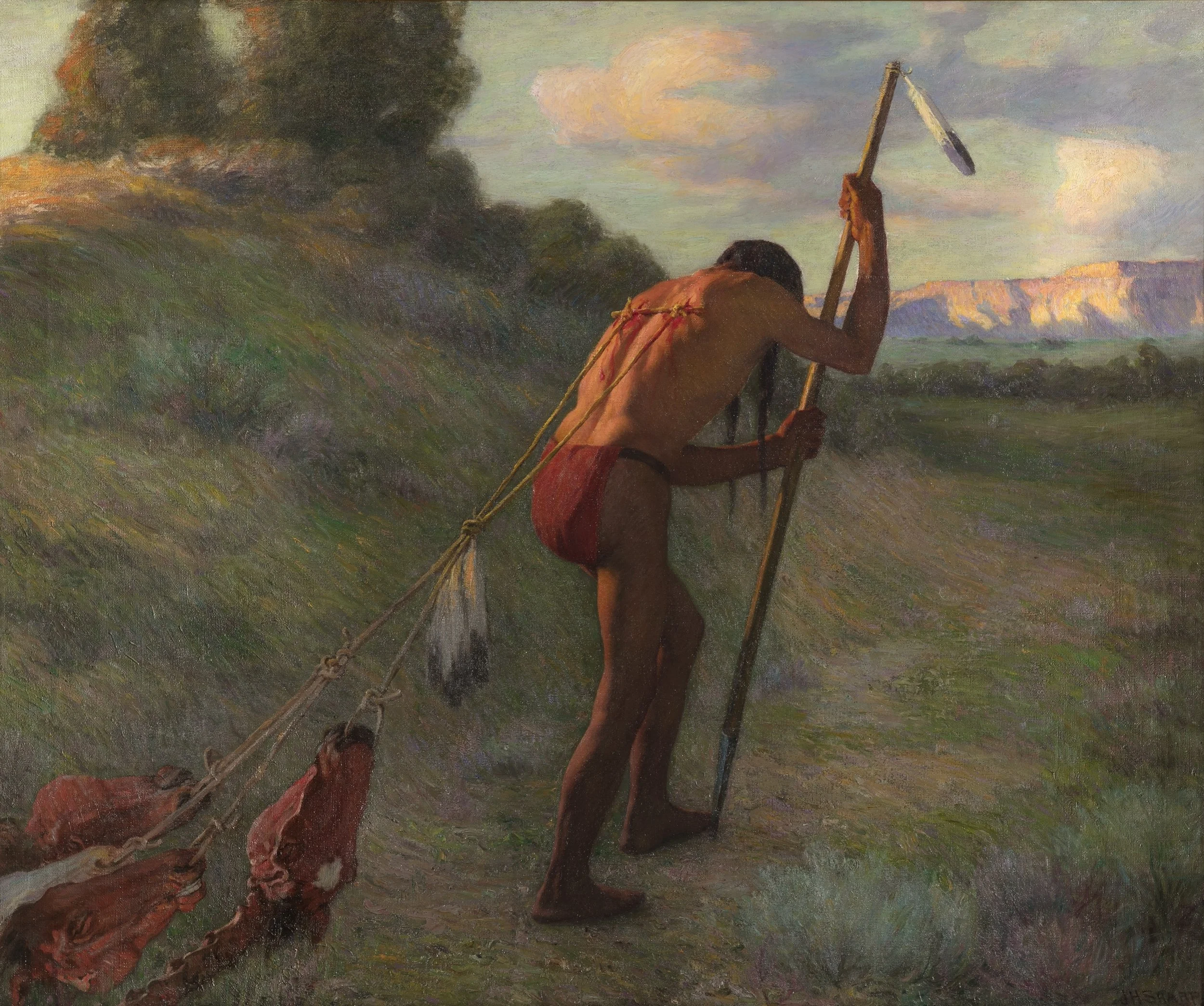
Joseph Henry Sharp, The Stoic, 1914, oil on canvas, 52 ½ x 61 ½ in. Collection of the New Mexico Museum of Art. Gift of Joseph Henry Sharp, 1917.
Multiple perspectives on an extraordinary image
While recovering from an eye injury at Absarokee Hut, his cabin at Crow Agency, Montana, Henry Sharp opened an exhibition of eighty-eight paintings in his hometown of Cincinnati in November 1912, a return to public attention after a two-year hiatus. The Stoic, which he completed in his Taos studio from Montana sketches dating to 1900, took top billing. Sharp included an explanation of the subject in the catalog:
“In supreme grief (as in the loss of a great warrior son) the Indian would tie buffalo thongs to the cut muscles of the back and drag pony heads over a hillside from sunrise to sunset, or until the muscles pulled loose, thereby proving his bravery and fortitude.”
However, the depiction is likely an interpretation with artistic license of a story told to Sharp during one of his excursions to the northern Great Plains, rather than the result of an eyewitness encounter. With its use of horse heads and involving only one mourner, the ritual has not been otherwise documented and is unfamiliar to modern-day tribes of the area.
The Stoic went on the circuit to positive critical recognition, showing at the 1913 Society of Western Artists exhibition in Chicago and at the 1915 Panama-California Exposition in San Diego. Without Sharp’s description, Los Angeles and Albuquerque critics perceived the image as an exotic New Mexican religious ritual and identified the figure as a flagellant and member of the Penitente brotherhood. Perhaps Sharp’s residence in Taos, and the fact that the painting hung in a venue of Spanish Colonial Revival architecture in California, contributed to the misconception. In the minds of many Americans, the geographically and culturally distinct Hispano, Pueblo, and Plains Indians cultures merged into a single, romanticized image of the “Southwest.”
Two years later, Sharp donated the painting to the New Mexico Museum of Art in Santa Fe, where it was exhibited in the Laguna Gallery. Sharp told a Taos Valley News reporter that The Stoic depicted a situation that deeply moved him. However, he said, it “might awaken criticism as a picture of barbaric cruelty, but it was life.”
Based on this explanation, Sharp arguably believed he had created an ethnographic document, or possibly a narrative history or genre painting depicting universal themes of the human spirit—heroic quest, struggle and sacrifice, courage. The life-size Herculean figure in an unfamiliar religious scene may be repackaged classicism from his Academic training.
The Stoic was completed during a time of change for Native American communities across the country. In this period, the US government agreed on treaties with the Northern Plains tribes that removed them from their homelands. The policies set upon them caused a significant impact to their ways of life, changing them forever.
Because of his yearly stays at Crow Agency and his residence in Taos, Sharp would have been familiar with issues of cultural eradication and forced assimilation. Official US policy determined to integrate Native Americans into “mainstream society,” including a key initiative of banning religious practices that were outside the government’s interpretation of Christian norms.
Perhaps because of witnessing such changes, Sharp consciously painted the “vanishing Indian” trope that pervades American cultural history. In 1926, Sharp asserted, “In the past years I have seen many things and made studies that probably no other living artist ever saw, such . . . that if I do not paint them no one ever will.”