
The Taos Society of Artists
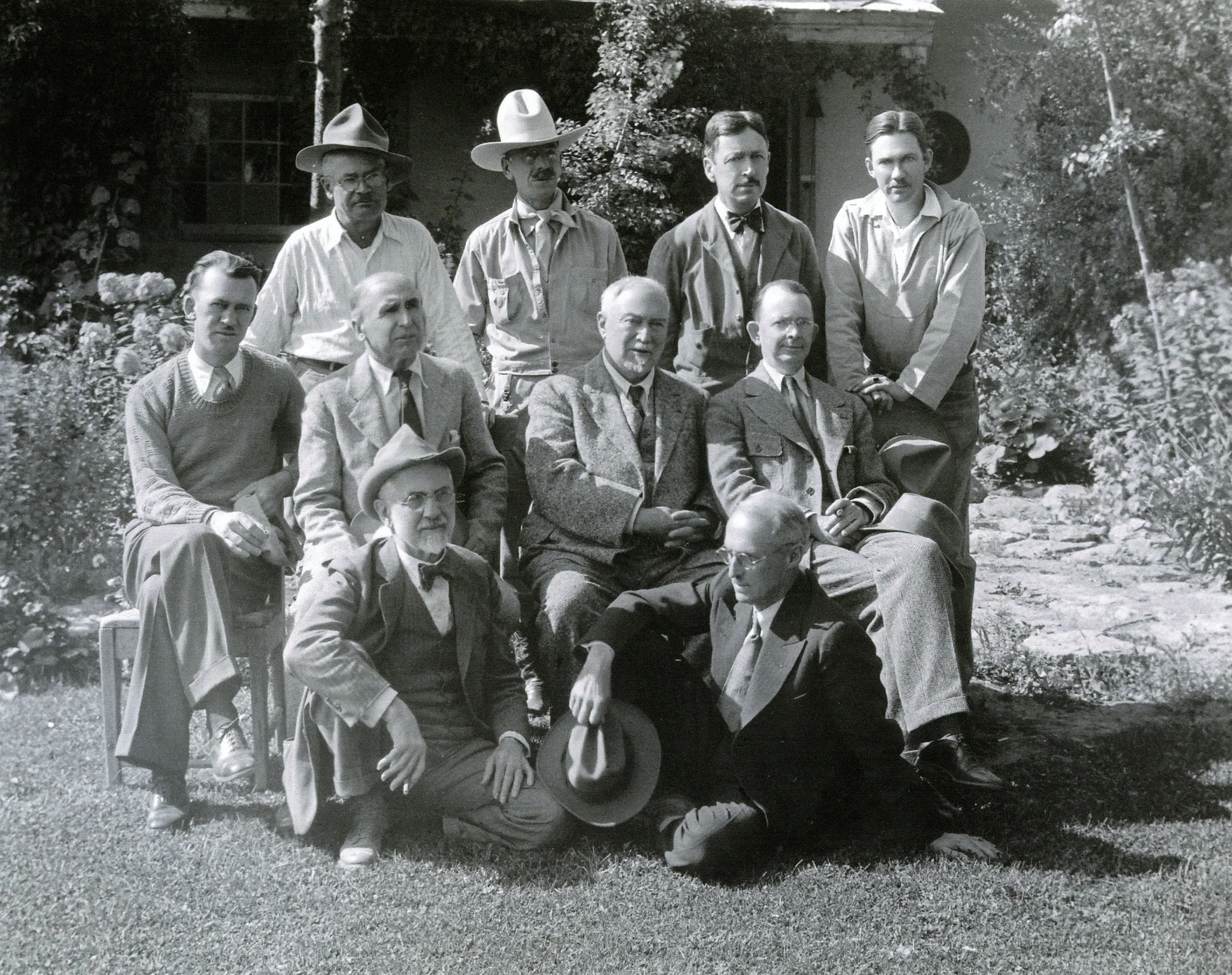
Ten of the TSA members in the Couse Garden, 1934. Top row from left: Ufer, Dunton, Higgins, Adams. Second row: Hennings, Phillips, Couse, Berninghaus. Bottom row: Sharp, Blumenschein.
Six artists founded the Taos Society of Artists in July 1915:
Oscar E. Berninghaus, Ernest L. Blumenschein, Eanger Irving Couse, W. Herbert Dunton, Bert Geer Phillips, and Joseph Henry Sharp.
The mixture of cultures in the northern New Mexico village, the Sangre de Cristo Mountains and Taos Plateau, and the inhabitants of all, inspired these accomplished artists to band together. They shared a desire to create a truly American art with authentic American subject matter.
An important initiative was establishing an annual traveling exhibition circuit for their paintings. Having a regular presence in important art centers such as New York and Chicago promoted their work and helped the artists become successful, widely known, and influential.
All had academic training in the United States or Europe. Sharp first encountered Taos in 1893. Phillips and Blumenschein visited—by accident—in 1898, with Phillips staying as the first permanent Taos resident of the group. Berninghaus experienced Taos in 1899, followed by Couse in 1902. Dunton arrived in 1912. Most spent summers in New Mexico and winters in the East for years before settling permanently in Taos. The bylaws of the society required members to have worked in Taos for three consecutive years.
When it dissolved in 1927, the Taos Society of Artists numbered twelve active members: the original six plus Kenneth Adams, Catharine Carter Critcher, E. Martin Hennings, Victor Higgins, Julius Rolshoven, and Walter Ufer. It also counted seven associate members (Gustave Baumann, Randall Davey, Albert L. Groll, Robert Henri, B. J. O. Nordfeldt, Birger Sandzén, and John Sloan) and two honorary members, Edgar L. Hewett and Frank Springer.
Although the artists painted similar subjects—the day-to-day and ceremonial lives of Puebloan, Hispano, and Anglo people, and the landscape and wildlife around Taos—their styles and approaches varied greatly. As the success and fame of the Taos Society of Artists increased, more artists came to the village, which grew in size and popularity with both artists, art seekers, and tourists. Today, Taos is still an important art center with an influence far larger than its size and rural setting would imply.