
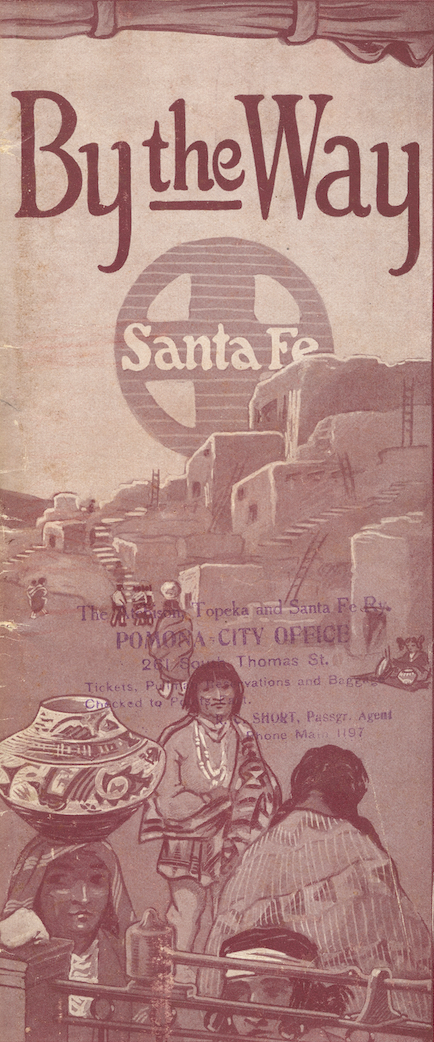
Front cover of “By the Way: A condensed guide of points of interest along the Santa Fe lines to California,” a folder published by the Atchison, Topeka & Santa Fe Railway, 1926. Drawing by Fay Turpin.
By the Way: The Taos Society of Artists and popularizing the Southwest
At the dawn of the twentieth century, the United States entered a new age of mass media and mass consumption of popular goods. A burgeoning middle class with the means to travel was hungry to see the nation. Advertising, photography, lithography, magazines, pulp fiction, railroad promotions, motion pictures, and everyday printed ephemera carried images even farther than before. The age of mechanical reproduction was in full swing, and technology joined with art and creativity to serve commercial means.
During this period of rapid change, many Americans were searching for images and objects that seemed to offer an antidote to industrial life, even if it was only aspirational. Indigenous art, Native subjects, and the Southwestern landscape became central to this desire.
This moment is often descried as the “Indian craze,” a widespread late nineteenth- and early twentieth-century fascination with Native American culture. Woven baskets, pottery, blankets, beadwork, and other objects appeared in homes, department store windows, traveling exhibitions, classrooms, and tourist spaces. People arranged “Indian corners” in their parlors and living rooms. Department stores sold Native objects alongside luxury goods under electric lights.
In addition, railroads and tourism companies promoted the Southwest as a place where travelers could encounter beauty, tradition, and an escape from the industrialized world.
Founded in 1915, the Taos Society of Artists emerged at this heightening confluence of mass media and a budding popular culture. Out of the six original founders, E. I. Couse, W. H. Dunton, and O. E. Berninghaus are prime examples of artists who navigated between fine art and commercial media.
Dunton was an illustrator whose work appeared in popular books, widely circulated magazines such as Collier’s and Cosmopolitan, and in newspapers. Berninghaus created advertisements for Anheuser-Busch. Couse’s work was especially important with the Fred Harvey company and the Atchison, Topeka & Santa Fe Railway. The TSA helped popularize a visual language of the Southwest that is still prevalent today.
These reproductions made Taos visible to national and international audiences. The images promoted an idealized and heavily romanticized version of a broad Native American Identity set in a fictional past. Yet the people depicted in them were real individuals, living in the modern era, navigating and forming connections across cultures.
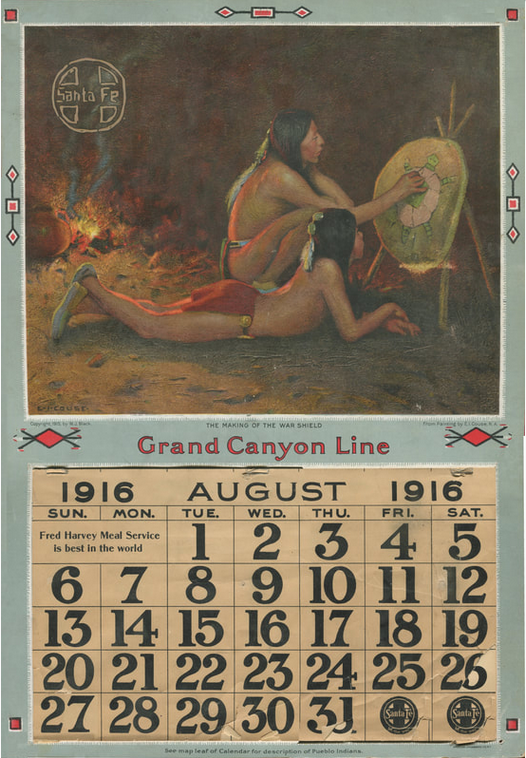
E. I. Couse, The Making of the War Shield, reproduced in the 1916 AT&SF Railway annual calendar. Image courtesy of the Harry J. & David Briscoe collection.
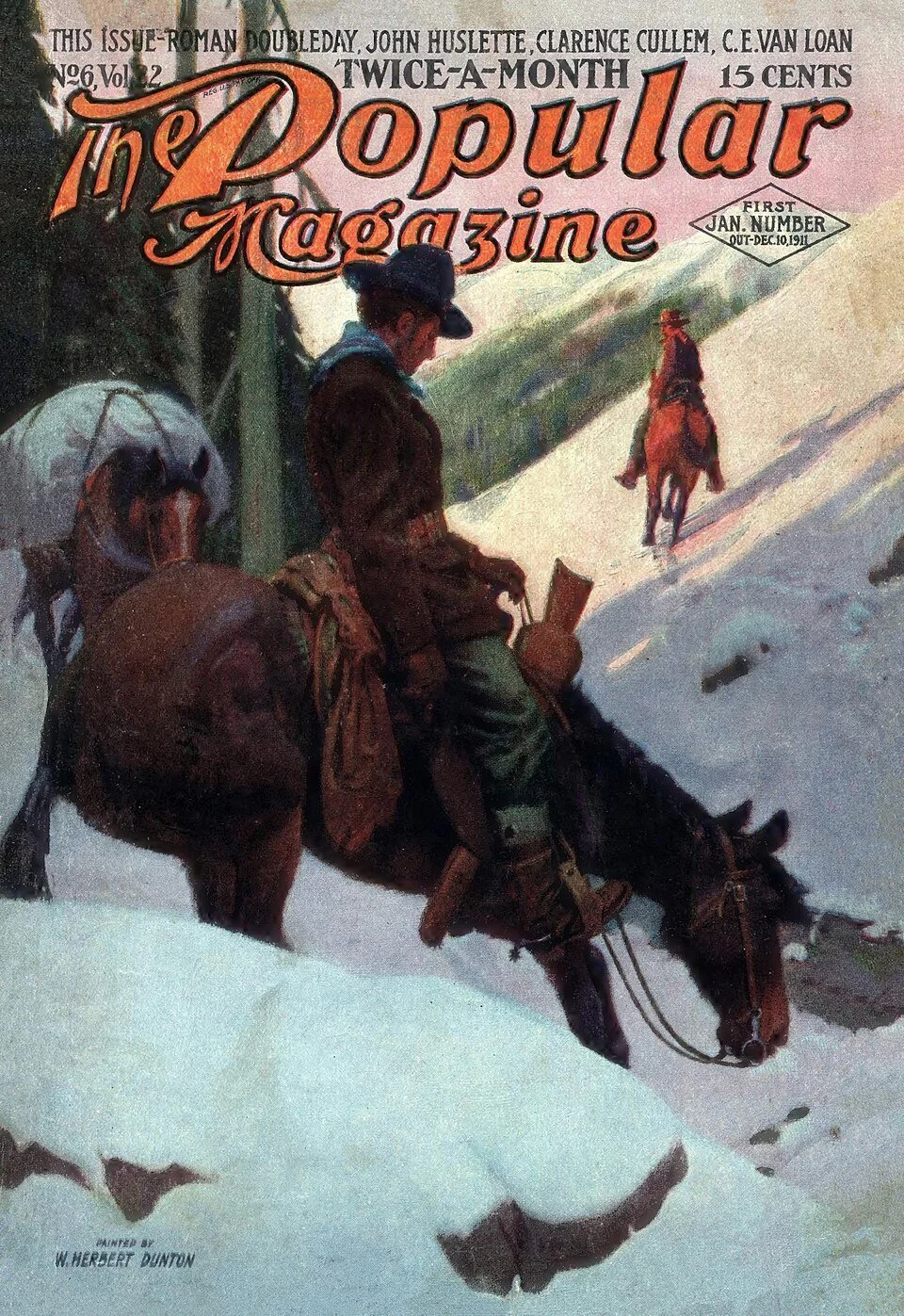
W. Herbert Dunton (1878–1936), untitled illustration in the January 1, 1912, issue of The Popular Magazine. Public domain image.