
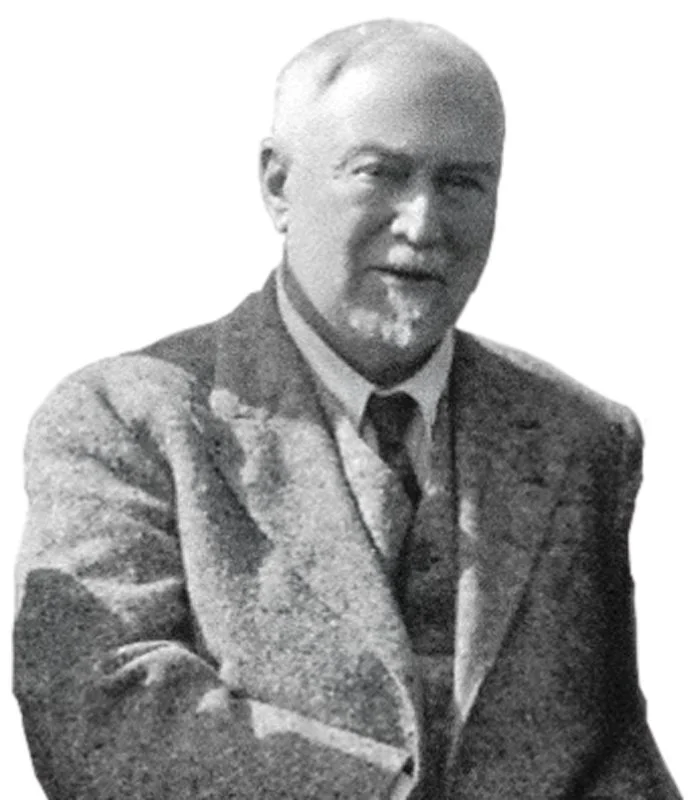
Eanger Irving Couse (1866–1936)
E. I. Couse, one of the founding members of the Taos Society of Artists and its first president, is perhaps best known to residents of Taos because he lived and worked in the Couse House on Kit Carson Road. In 1909, Couse and his wife, Virginia Walker Couse, purchased the house originally built by the Luna family in the 1830s and enlarged it over the years to include, most importantly, a large painting studio.
Irving Couse came to Taos initially on the advice of Ernest Blumenschein, who suggested it might be less difficult to find Native American models willing to pose in Taos than in the Northwest. Couse and Virginia had been living temporarily on the Walker family ranch in Washington state. Apparently, the Klickitat people living near the ranch had chased Couse away when he tried to paint their camps. Eventually, he made peace with them.
In Taos, Couse first hired Juan Concha, whose twelve-year-old nephew, Ben Lujan, soon became one of Couse’s main models, posing for paintings from 1902 until 1936. Jerry Mirabal, another of Couse’s regular models, began posing in 1907.
Couse was, above all, a figure painter, having developed a love of figure painting at the Académie Julian in Paris, where he mastered anatomy and the ability to paint skin tones. He studied for five years under William-Adolphe Bouguereau, the quintessential salon painter of his generation, whose genre paintings of mythological figures favored depictions of the female form. Couse, by contrast, most often painted men, including images of women only rarely and most of those in courtship scenes.
Couse received many prestigious honors and prizes for his work so that by 1907 he was, according to Virginia Couse Leavitt, “all the rage in New York.” In time, his work was known even more widely across the US because of the Atchison, Topeka and Santa Fe Railway calendars that reproduced his oil paintings as color lithographs. Over two decades beginning in 1914, the railway company featured Couse’s art, drawing for the most part from his existing inventory of paintings that depicted the peaceful domestic and artistic pursuits of Indigenous people.
Couse once told a reporter that he liked the simplicity, or what he called the “primitiveness,” of life in Taos. That view was not always shared by Virginia, who, shortly after the couple’s arrival in 1902, was horrified to discover that “the undertaker and the butcher are one and the same here; the coffins and beef hang side by side.”
At that time, the Couses were renting a three-room adobe house behind the Colombian Hotel that was owned by Felipe Guttman, coincidentally a relative of the Luna family members who built both the Luna Chapel and the attached house now known as the Couse House.
In 1935, roughly a year before Couse’s death, Spud Johnson wrote an affectionate portrait of the artist revealing, among other things:
“In his youth, he [Couse] was an enthusiastic baseball player, his only known sporting activity. He is still an ardent fan and might easily be termed a human encyclopedia on the game. He is also an ardent Movie Fan; and should his interest at any time go on the wane, it would seriously reflect itself on the theatre’s dividends.”
Couse Gallery
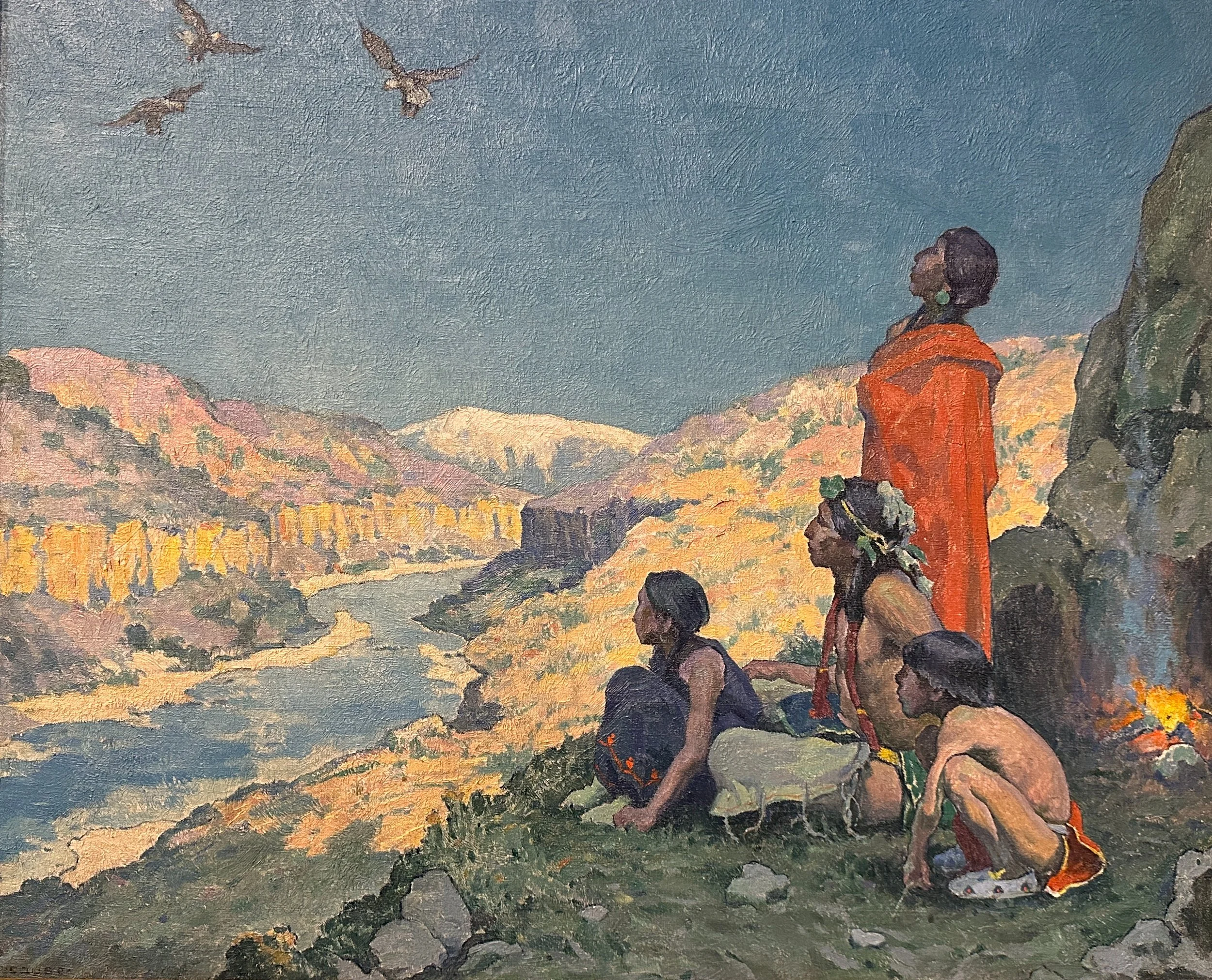
Eagle Watchers
E.I. Couse, Eagle Watchers, oil on canvas, 24 x 29 in. Collection of Koshare Art Museum, La Junta, CO.
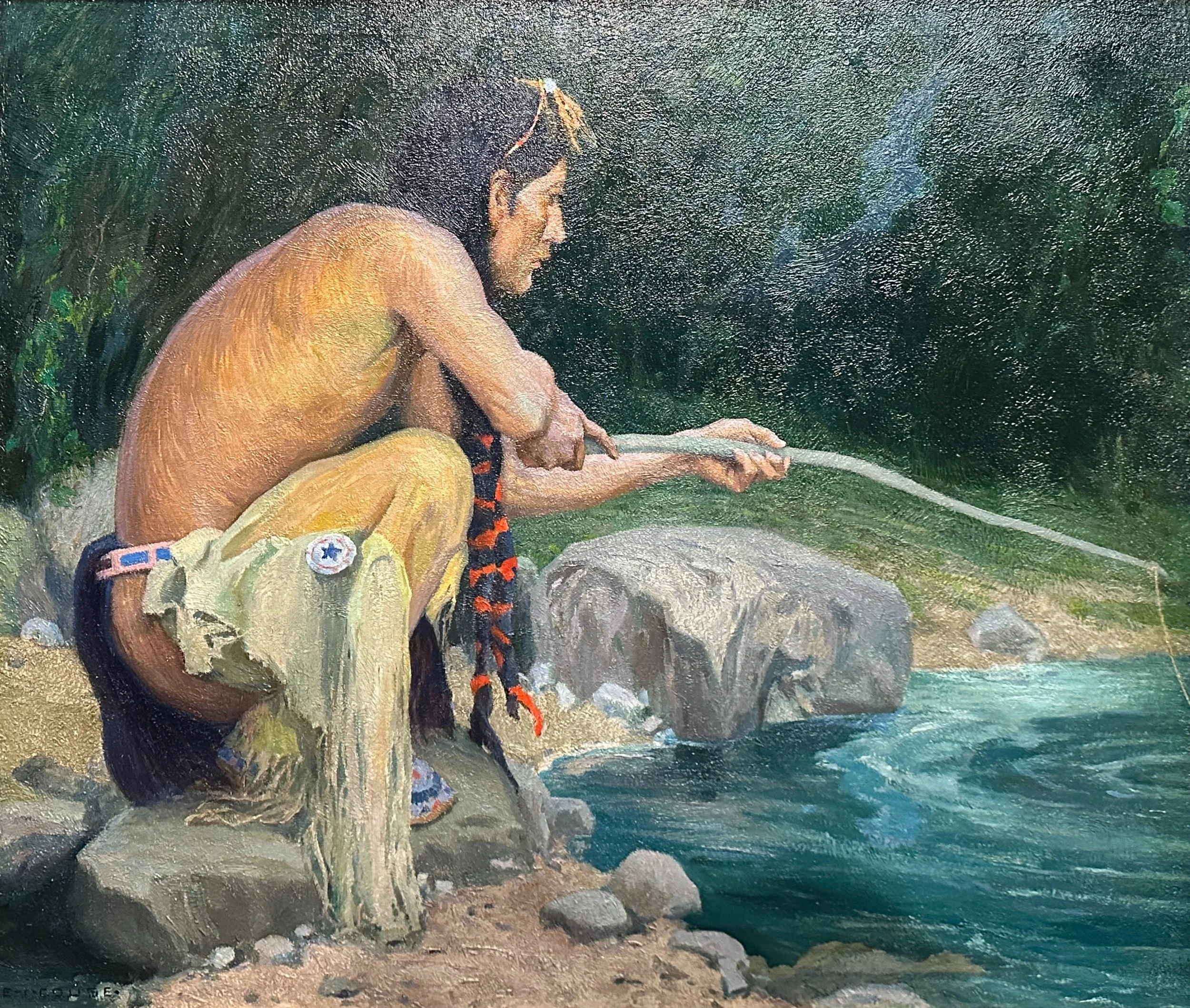
A Native Fisherman
E.I. Couse, A Native Fisherman, oil on canvas, 30 x 36 in. Collection of Koshare Art Museum, La Junta, CO.